
Political Deepfakes Incidents Database
Political deepfakes and cheapfakes, public opinion, detection, labeling, and computational research methods
Synthetic media and political influence
Politicians, campaigns, and their supporters use synthetic media to attack opponents, build support, and entertain audiences. We investigate these political uses, their implications for public opinion and accountability, and responses such as labeling and detection.
Our research
Political uses and circulation
Synthetic media can discredit opponents, celebrate candidates, or turn political figures into objects of satire. We examine how the content is presented, whether its origins are disclosed, and how it circulates.
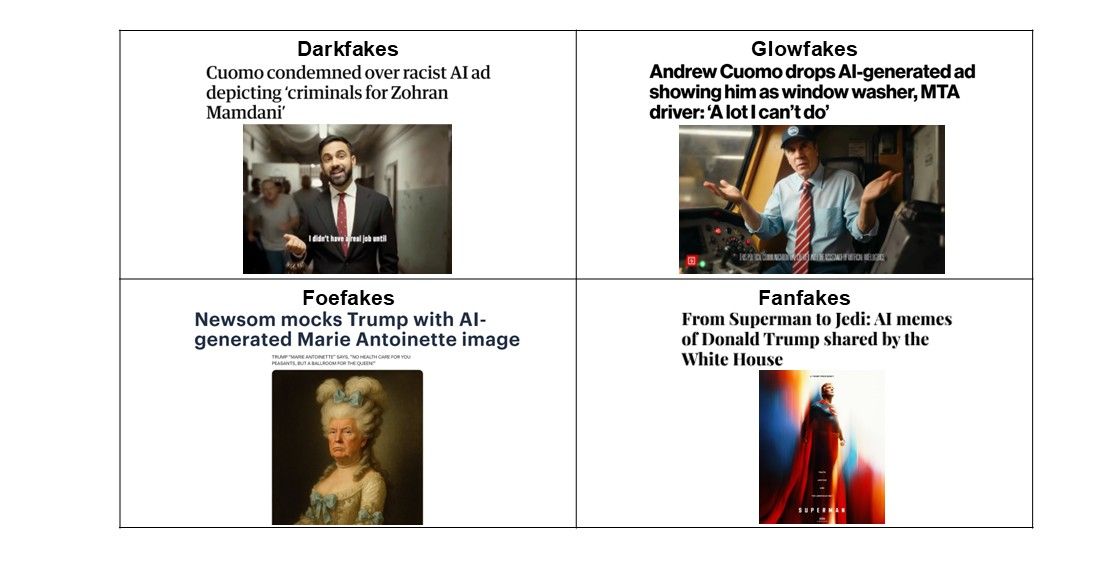
| Realism | Negative portrayal | Positive portrayal |
|---|---|---|
| Realistic | DarkfakesAttacks that discredit their subjects | GlowfakesPromotion that glorifies their subjects |
| Unrealistic | FoefakesSatire or mockery of their subjects | FanfakesFictional celebrations of their subjects |
Campaign examples
Andrew Cuomo’s campaign used AI advertising to portray him doing jobs around New York City. Other political figures have shared images of opponents in absurd situations or favored candidates as superheroes.
AI-generated images
Public opinion and accountability
Through survey experiments, we examine how people respond to political media and claims that genuine evidence is fake.
The liar’s dividend
In survey experiments, we have examined whether politicians can retain public support by falsely dismissing genuine evidence of misconduct as fake. This benefit is known as the “liar’s dividend.”
The Liar’s Dividend: Can Politicians Claim Misinformation to Evade Accountability? American Political Science Review ↗Watermarking and labeling
We study how disclosures of AI-generated content affect what people recognize, believe, and share. Our experiments compare different watermark and label designs across realistic and artistic political images.
Disclosure design
We examine the visibility, placement, and wording of disclosures, as well as how people interpret them. The research considers both identifying synthetic media and understanding the claims it conveys.
Deepfake detection
We evaluate how well detection tools recognize synthetic political images and videos that have circulated online.
Evaluating detection tools
We have compared tools from academia, government, and industry, examining their accuracy and vulnerability to media modifications.
Fit for Purpose? Deepfake Detection in the Real World Preprint · arXiv ↗Computational research workflows
We develop tools to find, classify, and organize political media across social platforms. This includes automated collection and ingestion, text and scene analysis, and workflows connecting machine-assisted coding with human review.
From posts to research records
These methods bring together posts, images, audio, and video; extract text and transcripts; and link related appearances of the same media. We are testing ways to screen for relevant content and assist coding while preserving the original sources and their context.
Explore the PDID
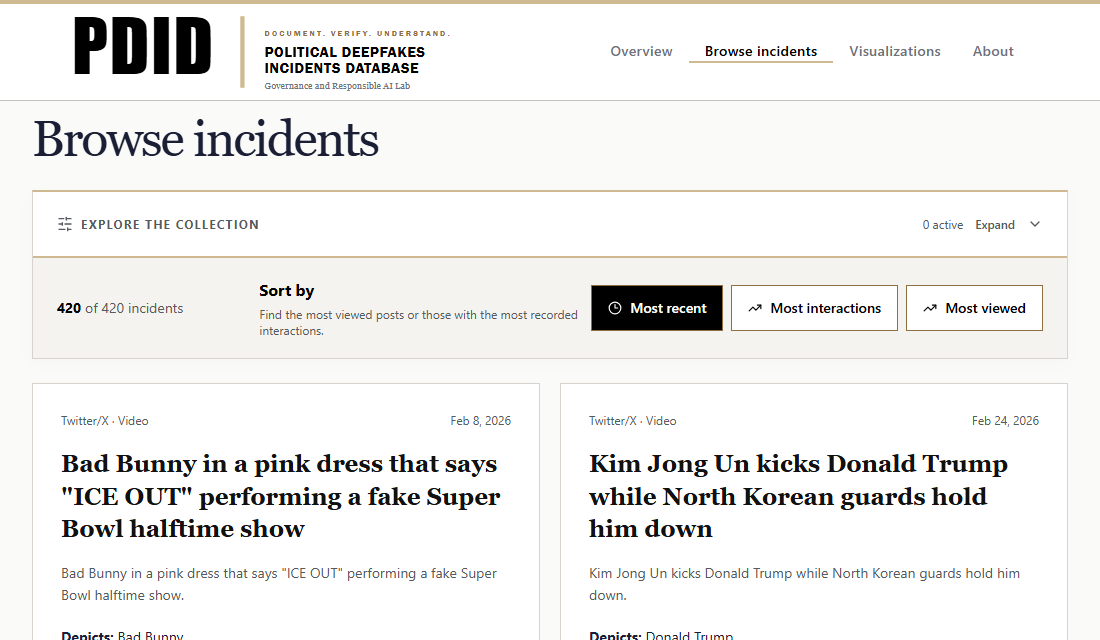
The PDID documents synthetic political media and simpler manipulations known as cheapfakes.
Read the PDID codebook ↗| Category | Examples |
|---|---|
| Media and authenticity | Image, video, or audio; deepfake, cheapfake, real, or unclear |
| Sources, sharers, and targets | Creators and sharing accounts; people or groups depicted; positive, negative, or neutral portrayals |
| Content and policy topics | Elections, scandals, government, war, and international relations |
| Disclosure and verification | Visible watermarks or AI labels; how the sharer presents the content; fact-checks |
| Framing and narratives | Communication goals; conflict, morality, or responsibility; heroes, villains, and plots |
| Circulation and harms | Views, likes, comments, and shares; harms depicted and documented consequences |
Subject matter
- Government / Legal System295
- Scandal138
- International Relations80
Communication goals
- Expressive entertainment300
- Propaganda245
- Educational informative75
Current contributors
- Alaina Hall
- Andrew Chen
- Annette Ruiz Millan
- Anshika Saxena
- Ariha Thanki
- Ayusha Patra
- Chloé Tremblay
- Christina Walker
- Clay Miller
- Daniel S. Schiff
- Donovan Luo
- Ervinas Meija
- Huy Nguyen
- Ishaan Singh
- Jaren Peters
- Jiashu Hu
See more current contributors
- JP Messina
- Katherine Connell
- Kaylyn Jackson Schiff
- Lillian Fix
- Lorenzo Fischetti
- Lydia Windell
- Maddie Phillips
- Narek Abelian
- Natalia Bueno
- Shria Kapisthalam
- Sowmyasree Nityakalyanam
- Stuthi Sai Sunil
- Trisha Hande